
Franklin City Directory Holdings
Franklin's historical directory trail is spread among the Franklin Public Library, the Massachusetts State Library, Internet Archive scans, and the Franklin Historical Museum. Each repository describes a slightly different run. The library's digital collection is the best local starting point because it groups resident and business directories with maps, valuation material, newspapers, and town records. A directory entry records a listing at the publication date. It does not establish a person's current address or prove that a property owner lived at a parcel.
| Collection | Years located | Where held | Access |
|---|---|---|---|
| First resident and business directory | 1884 | Franklin Public Library gateway and Internet Archive | Digitized item with 82 image pages in repository metadata |
| Resident and business directory | 1890 | Internet Archive and regional digitization | 142-page scan; inspect the town heading because nearby towns appear |
| Franklin directories | 1893, 1899, 1902, 1905, 1909, 1913 | Library collection, State Library holdings, and selected scans | Use the repository's year and title record |
| Lists of residents | 1909, 1911, 1913, 1914, 1924, 1949 | Franklin Public Library digital collection | Historical list material, not a current public feed |
The research located no confirmed Franklin reverse or criss-cross run, standalone obituary index, telephone-directory run, or funeral-home archive. Ask reference staff about physical holdings rather than treating an unverified category as available.
Franklin City Directory at the Library
The Franklin Public Library Local History and Genealogy Digital Collection is a central route for a historical directory search. Its resident-listing group includes the 1884 First Resident & Business Directory, 1890 History & Directory, the 1893, 1899, 1902, and 1905 material, Franklin resident lists, and a 1949 list. Reference staff support genealogy, databases, and digital materials at 118 Main Street. The library phone is 508-520-4941.
The library's local-history image provides a useful view of the collection gateway: open the Library's local-history collection before choosing a year or item.
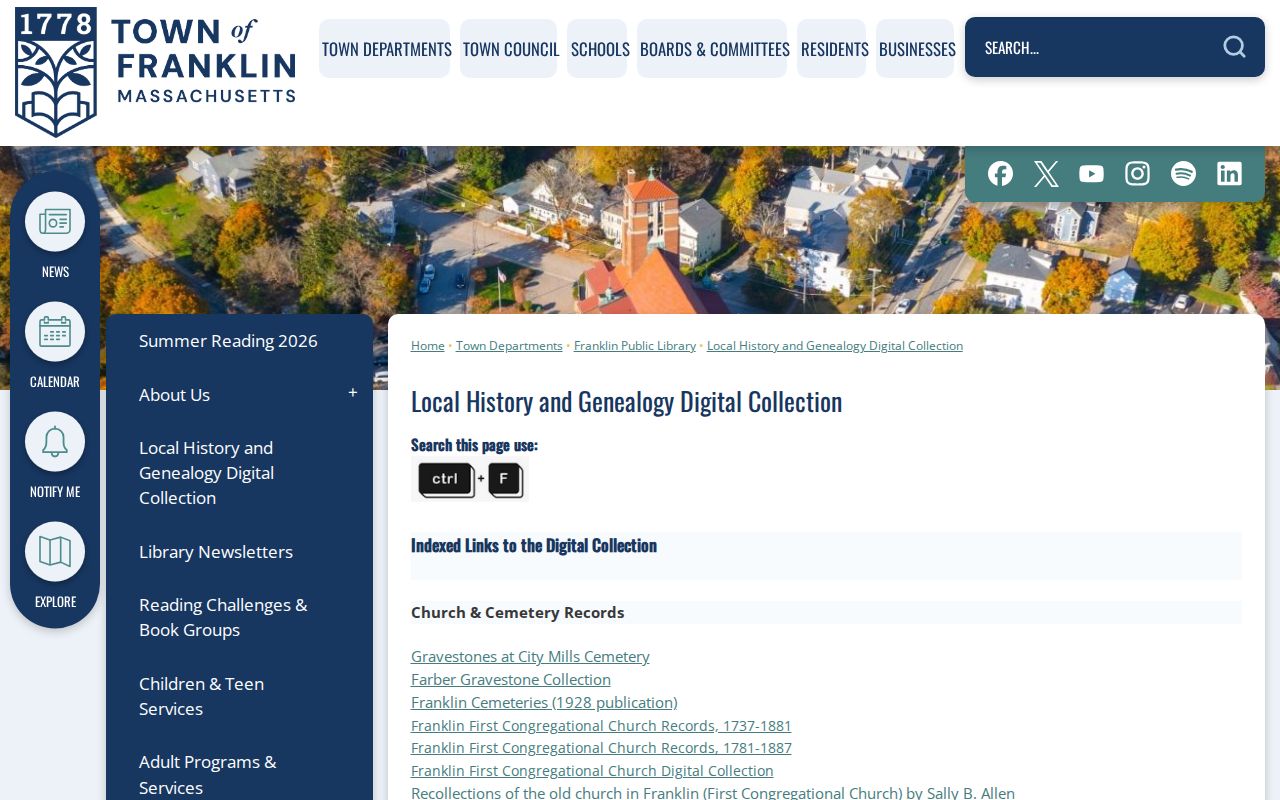
That collection also leads to Sanborn maps, poll-tax lists, valuations, church and cemetery materials, diaries, town meetings, and newspapers. Those companions help date a directory entry without changing it into a present-day claim.
Note: Begin with the library's year and title link so the item-level record stays attached to any page or image you save.
Franklin City Directory Scans by Year
The digitized 1884 volume is identified as the first published directory of the Town of Franklin. Its catalog record describes residents and local businesses. The 1890 title is a resident and business directory and carries a crucial local limitation: it covers Franklin and surrounding communities. Confirm the page heading before adding a result to a Franklin family timeline. The 1913 scan supplies another direct route, while the library and State Library catalogs identify additional holdings that may be a different edition.
The 1884 viewer is available through Internet Archive's Franklin directory item, which is the source represented below.
Use the image number and the published year when recording a result. OCR, when a repository supplies it, is helpful for discovery but should be checked against the scanned page because names and abbreviations can be read incorrectly.
Reading Franklin City Directory Entries
Franklin directory pages are commonly organized alphabetically by surname, with some volumes also offering street or address sections and business-by-type pages. The research did not transcribe one named entry, so the safest approach is to describe only fields visible in the edition and image being consulted. Preserve the publication year and page reference before interpreting an address or occupation. A business heading can refer to a business context rather than a household.
| Person or business heading | Visible in the alphabetical structure or a business section |
|---|---|
| Town heading | Shows whether the page concerns Franklin or another community in a multi-town volume |
| Address or residence line | Edition- and page-dependent; inspect the image instead of inferring from OCR |
| Occupation or business description | Edition- and page-dependent context for a listed person or institution |
| Year and page reference | Catalog metadata and viewer image reference needed for a reproducible citation |
- Criss-cross directory
- A directory arranged by street or address rather than surname. No separate Franklin run was confirmed in the research, so ask the library before relying on one.
- Householder index
- An index of household names, when an edition supplies one. It can help locate a listing but still reflects only that publication date.
- Abbreviation key
- A page that explains an edition's shorthand, if present. Photograph or note it before interpreting shortened address or business text.
Franklin Directory Dates in Context
Directory years are not interchangeable. The State Library's official holdings list identifies Franklin entries in 1884, 1886, 1890, 1893, 1896, 1899, 1902, 1905, 1909, and 1913. The library's local material also identifies lists from 1911, 1914, 1924, and 1949. A gap in one shelf is not proof that no directory was published or that a household left town. Check the title, repository, and page image before drawing a conclusion.
| 1884 | First published Franklin resident and business directory located as a digitized item |
|---|---|
| 1890 | Resident and business directory scan, with Franklin and surrounding-town material |
| 1893 to 1913 | Multiple Franklin directory years identified across library and State Library holdings |
| 1909 to 1949 | Franklin resident-list material in the local digital collection, with dates varying by item |
Franklin's 1778 incorporation, the 1785 book donation, and the 1790 free-lending vote give the collection an unusually long institutional setting. The Ray Memorial building was dedicated in 1904, another useful date when comparing local library records.
Franklin Museum Research Routes
The Franklin Historical Museum research page lists directories, yearbooks, annual reports, historical books, vital-record compilations, and GIS building or development story maps. Questions can be sent to franklinmuseum1778@gmail.com or rlowell@franklinma.gov. Physical work may require checking opening hours or arranging an appointment. The Historical Commission also notes that family-history researchers seek information about past Franklin residents and that old-home inventories can help with a building history.
The Museum research page is the cited source for this Franklin historical-directory research route.
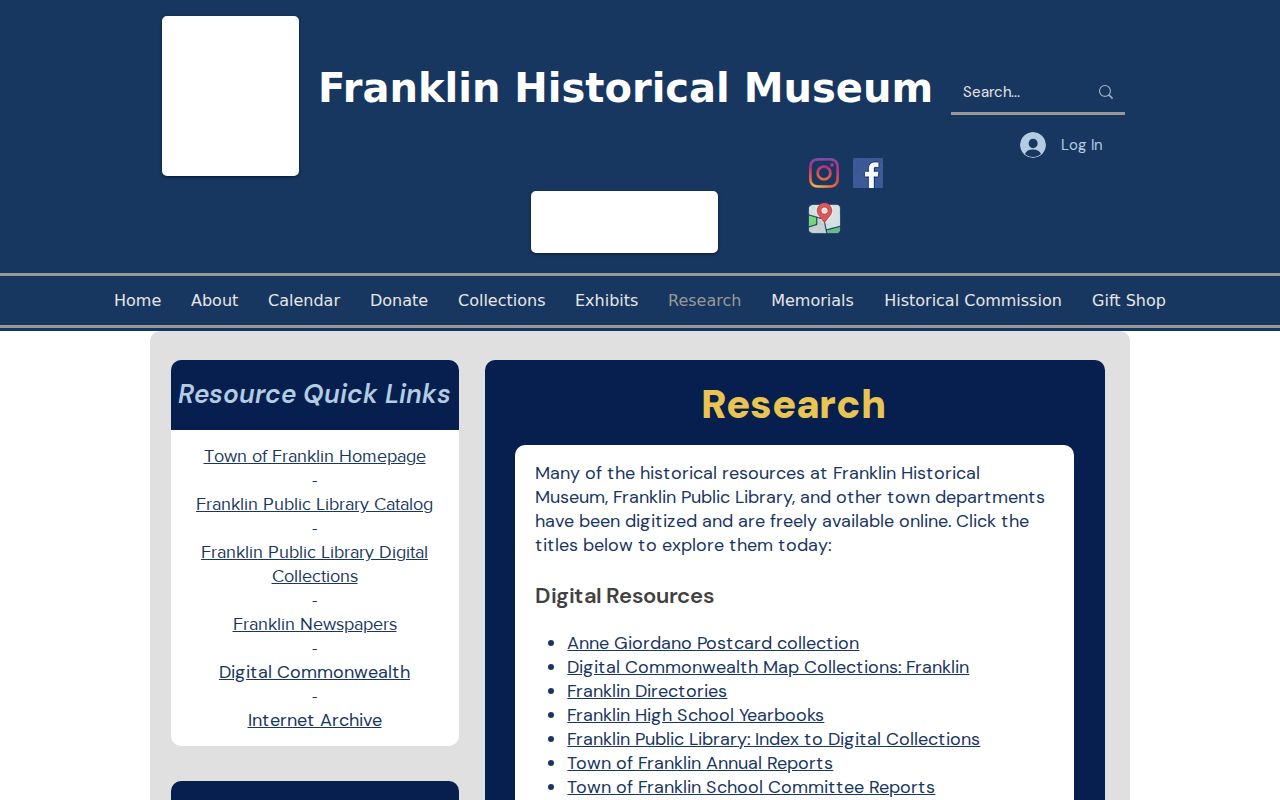
The Museum's collection makes it possible to connect a directory year to annual reports, local history, or a story map, while the original scan remains the source for the listing itself.
Tracing a Franklin Directory Household
Use a historical volume as one dated piece of a household trail. The State Library's guidance advises starting with a surname, checking alternate spellings, looking for street or address sections, and using business-by-type pages for an institution or shop. Franklin's library then provides nearby sources for the same period, including cemetery and church records, town material, newspapers, maps, and valuations. Keep each source year visible in your notes.
- Choose the clearest Franklin directory entry and record its full title, year, page image, and town heading.
- Check earlier and later confirmed directory years, including alternate spellings and initials.
- Compare the listed street or business context with a dated town map, valuation, or Sanborn sheet when available.
- Use church, cemetery, vital, or newspaper material from the library collection to test an event or family connection.
- Write the result as a dated historical listing, including uncertainty where a year or entry is missing.
A disappearance can reflect a move, death, changed spelling, omitted edition, or a listing under a different town heading. It should be treated as a research question, not a conclusion.
Franklin City Directories and Nearby Sources
Franklin's historical sources are strongest when used for the question each one can answer. The library holds town maps from 1795, 1832, and 1876; Sanborn maps for 1889, 1904, 1919, and 1927; valuation materials for 1868, 1889, 1896, 1929, and 1940; and a street-layout record spanning 1785 to 1921. Church records, cemetery indexes, diaries, ledgers, town meetings, military and club collections, and newspaper runs add context that one volume cannot supply by itself.
For present parcel geography or an address-keyed record, use the Franklin by-street directory route instead of treating a printed directory as current evidence. The historical shelf is best for reconstructing a particular period.
Note: A page or item citation is stronger than a broad collection link because it preserves the title, date, and exact evidence reviewed.
Why Franklin City Directory Headings Matter
The 1890 resident and business directory includes Franklin and surrounding communities. That creates a simple but important checking step: read the town heading before attaching an entry to Franklin. The same caution applies to a location that sounds familiar in an OCR result. A surname hit can be real while belonging to a different town section, and a page image is more reliable than a search snippet for that distinction.
This local detail also explains why street, town, and date are better starting terms than a name alone. The directory's own arrangement and the library catalog offer the context needed to separate a Franklin entry from a nearby one.
Franklin City Directory Research Limits
A printed directory, resident list, poll-tax list, map, valuation, deed, or museum note records a particular relationship at a particular time. It does not prove current presence, identity, or a complete household. Franklin is in Norfolk County, not Franklin County, so county research must use the Norfolk Registry and courts when a historical question moves beyond the library collection. Protect confidential addresses and do not combine dated fragments to identify a person's current location.
When a record is missing or restricted, the honest result is a gap. A reference librarian, Museum contact, clerk, or the record custodian can explain the appropriate next route without turning an old directory into a modern people list.