
Franklin Previous Residents by Era
The sources for past residents of a Franklin address change with the era. Current assessor and GIS material provides a starting parcel context, but it does not state the full history of a house. The Norfolk Registry connects a transfer trail to legal descriptions and plans. Franklin’s library collections add dated directories, resident lists, maps, valuation books, and newspapers. Use a source’s own year as the starting date and leave a gap visible when the source does not identify its online or archival coverage.
| Source | Years it covers | Where held | What it can show |
|---|---|---|---|
| Franklin assessor and GIS | Current assessment presentation; fiscal year not located | Town GIS and Assessors | Current parcel and assessment context |
| Norfolk deed index | Online start year not located | NorfolkResearch and Registry | Recorded land instruments and a deed chain |
| Franklin directories | 1884, 1890, 1893, 1899, 1902, 1905, 1909, 1913; 1949 list material | Library, State Library, and digitized scans | Publication-year name, address, or business context where the edition shows it |
| Resident and poll lists | 1909, 1911, 1913, 1914, 1924, 1949; State Library examples 1924, 1978, 1980 | Franklin Public Library and State Library | Historical list, registration, or tax context |
| Sanborn maps | 1889, 1904, 1919, 1927 | Library and digitized repositories | Mapped building footprint and use, where a sheet covers the address |
| Federal census | Decennial; public online through 1950 | National Archives and recognized genealogy repositories | Household snapshot for its census date |
| Building permits | Current OpenGov route; historical start not located | Franklin Building and Inspections | Public construction or alteration timing where retained |
Start with a current parcel or a dated deed if the question concerns ownership. Start with a Franklin directory or resident list if the question is about a household at a published date. The Registry’s online cutoff and the start of Franklin’s permit archive were not located in official sources, so confirm both directly with the custodian before deciding the trail ends.
Franklin Directory Dates and Gaps
Franklin’s historical listing trail is unusually well documented, but it is not continuous. The Franklin Public Library digital collection identifies resident and business directories for 1884, 1890, 1893, 1899, 1902, 1905, 1909, and 1913, plus Franklin Lists of Residents and related historical lists. The Massachusetts State Library holdings list separately identifies Franklin directory holdings in 1884, 1886, 1890, 1893, 1896, 1899, 1902, 1905, 1909, and 1913. Cataloged years should be kept distinct from an unverified run.
The 1890 digitized resident and business directory has 142 pages and includes Franklin and surrounding communities. Confirm the town heading before connecting an entry to a Franklin address. A printed entry can use a surname, a business, or an address line, depending on the edition and page. Its value is the publication date, not an implication about later occupants. The underlying collections are described in more detail in the Franklin city directories.
Note: A reverse or criss-cross directory, telephone run, and standalone obituary index were not located in the official Franklin research.
Franklin Sanborn Maps and Buildings
Sanborn fire-insurance maps add physical evidence to a previous-residents search. Franklin has documented map years of 1889, 1904, 1919, and 1927. A covered sheet may show a building footprint, construction material, use, and nearby structures. It cannot establish a household by itself, and the absence of an address from one sheet does not prove the building was absent from town. Sheet coverage and the map date both matter.
The 1889 Franklin Sanborn item provides a dated historic-map entry point.
Pair a Sanborn sheet with the street-layout record, valuation materials, and a deed or plan rather than treating the map as a complete account of a Franklin address.
Franklin House-History Leads
The Franklin Historical Commission identifies past residents and old-home inventories as established local research uses. Its material points to old-home resources and Stanley Chilson films from 1935 to 1963. The Franklin Historical Museum also lists directories, yearbooks, annual reports, vital-record compilations, historical books, and building-development story maps as research resources. These sources help connect a house to a time and neighborhood story without making a present-day residence claim.
Franklin Historical Commission activities describes the local old-home and past-resident research context.
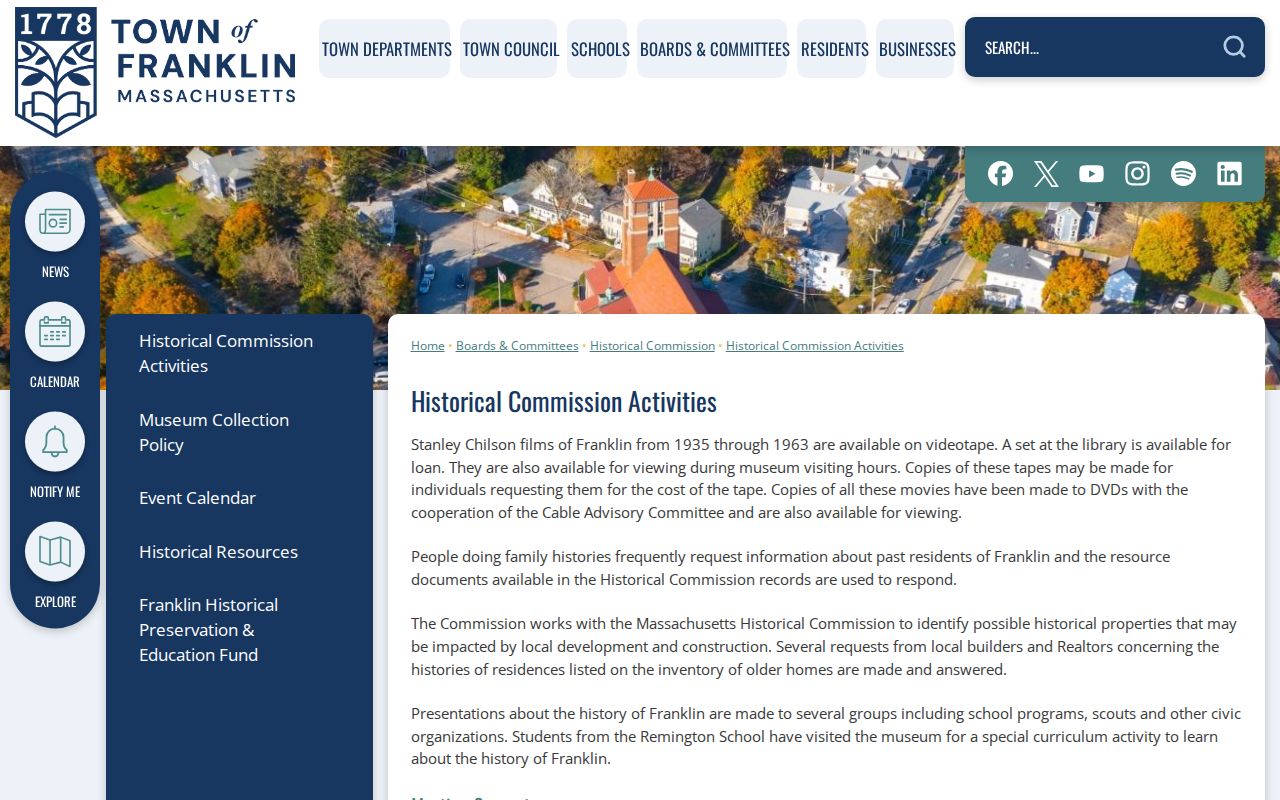
The Commission material supports a five-source house history: street-layout record, closest Sanborn sheet, valuation source, Registry instrument or plan, and the current Franklin GIS parcel.
Trace Norfolk Deeds Backward
The Norfolk County Registry of Deeds is the legal route for Franklin deed history. Search the official Registry research portal by owner name and town, then read the specific instrument. A deed can identify grantor and grantee, recording date, instrument type, book and page or document number, legal description, and references to plans or earlier instruments. A mortgage or discharge may explain a transaction without changing the current assessment record.
- Begin with the current Franklin property record and retain the property location, parcel context, and any legal-description lead it supplies.
- Search the current owner in NorfolkResearch with Franklin as the town, then open the purchase instrument that matches the parcel context.
- Read the named seller in that instrument as the earlier party, then search that person’s earlier acquisition as a grantee. Match book, page, document, legal description, and plan references at each step.
- Repeat only when the instrument trail supports the match. Check both recorded and registered land routes if the parcel history points that way.
- If the web result reaches a gap, ask the Registry about the relevant book, plan, or counter research. The official sources inspected do not state the online index’s first year.
- Grantor and grantee
- The grantor transfers an interest. The grantee receives it in the recorded instrument.
- Chain of title
- A sequence of recorded instruments used to follow legal interests in a parcel through time.
- Legal description
- The land description in the instrument. It can remain useful when a street address changes or a parcel is altered.
- Recorded and registered land
- Two Registry and Land Court paths that can coexist in a Franklin parcel history.
Franklin Recorded and Registered Land
A Franklin previous-residents trail can fail when the search assumes every land record takes the same path. The Registry distinguishes recorded land instruments from registered land maintained through Land Court registration. A parcel may include both kinds of components. The Registry also notes that it holds plans of land but not plot plans or mortgage surveys, so a map or plan result is not a final boundary opinion.
Use the deed’s book, page, document number, legal description, and plan reference to decide what to request. If an old address does not align neatly with the current parcel, preserve the conflict and investigate the dated street-layout record or plan. It is safer to report an unresolved match than to force an address into a chain it does not support.
Franklin Past Households in Context
Owners are only one part of a Franklin address history. A dated directory, resident list, poll-tax list, newspaper, church record, cemetery index, or census schedule can add the household layer. The Franklin Public Library collection includes poll-tax lists for 1911, 1914, and 1924; resident-list material for several early twentieth-century dates and 1949; and church, cemetery, town-record, and newspaper sources. None should be used as evidence of a current address.
- Choose a dated Franklin directory or resident list nearest to the target period and record the title, year, town heading, and page or image reference.
- Pair that publication year with the closest available federal census year, keeping the census as its own dated household snapshot.
- Compare the street or address only when each item actually displays it. Preserve spelling variants and do not infer missing fields from OCR.
- Use a Franklin Sentinel or Register item, church or cemetery record, and an appropriate Norfolk Probate record to investigate an estate or family-history endpoint.
Obituary coverage is not a verified standalone index in the researched Franklin sources. The documented fallback is the library’s newspaper gateway and reference desk, followed by the appropriate court record when an estate question is involved.
Franklin Street Layout Record
The Town’s “Record Of Laying Out Of Streets Franklin, Mass. 1785–1921” is a valuable bridge for a historic address. It can establish a road layout or older street context, while the library’s 1795, 1832, and 1876 maps and the Sanborn years can test the physical setting. The research did not establish a complete street-renumbering or street-name-change history. A claimed old-to-new address bridge therefore needs a page-level citation from the street record, Town Clerk, Assessors, or GIS.
This is a Franklin-specific point of care. A directory may display an old form of a street, an older parcel may have been divided, or a map may cover only part of town. The proper conclusion is a dated, sourced relationship between records, not a present-tense residence assertion.
Note: Record the source year and repository for every address clue, because Franklin maps, lists, deeds, and GIS cards are different snapshots.
Franklin Previous Residents Limits
Previous-residents research is appropriate for house history, family history, estate questions, and local history when it stays within public access rules. A directory listing, deed party, assessor mailing field, or map label shows a specific recorded relationship at a particular time. It does not establish a person’s current location. Franklin and Massachusetts sources also protect confidential voter and Address Confidentiality Program information, and those protections cannot be bypassed with a historical trail.
Use the least sensitive official record that answers the historical question. Do not combine dated records to locate, follow, contact, or expose a living person. When a source is sealed, restricted, or unclear, ask the identified custodian about the lawful route rather than trying to fill the gap from unrelated fragments.
Lawful use. Franklin house-history research belongs to personal, family, civic, and estate questions. Do not use past-resident records to stalk, harass, threaten, or harm anyone.