
Franklin Resident Lookup Records
Use the source that matches the question. A Franklin resident lookup can establish a dated record relationship, but it does not create a complete current list of people. The Town's property links describe a parcel and assessment context. A voter record concerns registration. A court docket identifies a party to a proceeding. A directory records what a publisher printed for a particular year. Start with the least sensitive source that supplies enough context, and label each result by its date and keeper.
| Record | What it can confirm | Official keeper | Access route |
|---|---|---|---|
| Property card or parcel layer | Assessment context, parcel location, and record-owner or mailing fields | Franklin GIS and Assessors | Town-linked portal, office, or public-record request |
| Voter registration record | Registration information at a date, subject to public-field rules | Massachusetts voter services and Franklin Town Clerk | Status verification or a municipal request |
| Public court docket | Case party, court, filing date, and procedural status | Massachusetts Trial Court Case Access | Online search, courthouse kiosk, or clerk route |
| Vital record | Event or family relationship within statutory access rules | Franklin Town Clerk or RVRS | Local, mail, online, state, archive, or library route |
| Historical directory | A past printed name, address, business, or household context | Franklin Public Library | Digital collection and reference help |
Franklin is in Norfolk County, not Franklin County. That small distinction matters when selecting a registry, court, or probate route. A parcel owner, a tax mailing address, a docket party, or a historical listing is not proof that a person currently lives at a Franklin address.
Franklin Name Match Checks
Same-name errors are common. Preserve the spelling, initials, suffix, and punctuation as printed, then test the format that the official source accepts. Historical directory volumes may include nearby communities, so check the town heading before treating an entry as Franklin. Compare independent details such as the date, middle initial, family relationship, parcel, or street. A failed search can mean an unindexed year, a former name, a privacy rule, an OCR error, or a different municipality.
- Write the name exactly as it appears in the record already in hand.
- Confirm that the town is Franklin in Norfolk County and note the date.
- Search a second official source that answers a different question, not the same source again.
- Keep both matches and nonmatches with the source date and any name variation.
For a historical household, the library's directories, newspapers, church and cemetery sources, town records, and maps can add context without turning an old listing into a claim about the present. The local collection includes resident and business directories from 1884 through 1913, with additional local list material.
Note: Treat a dated entry as evidence of that publication or record, not as a present-tense location statement.
Franklin Court Lookup Limits
Massachusetts Trial Court Case Access is a preliminary route for a public docket question. Franklin is served locally by Wrentham District Court, while Norfolk Probate and Family Court serves probate and family matters. Select the court department first. The search instructions describe department, division, location, name, case type, case number, and ticket or citation routes. A name search is primarily associated with civil cases and does not function as a universal criminal name search.
The court portal's warning is essential: online information is not the official record and may omit recent activity. For a complete or certified file, use the clerk or register and the courthouse public-access computer kiosk under the Trial Court rules. Some files are sealed or restricted, and remote access differs by case type. A docket party is a case relationship, not a residence finding or a description of personal character.
The Trial Court search screen shows the public-record entry route and its caution that online results are not the official record.
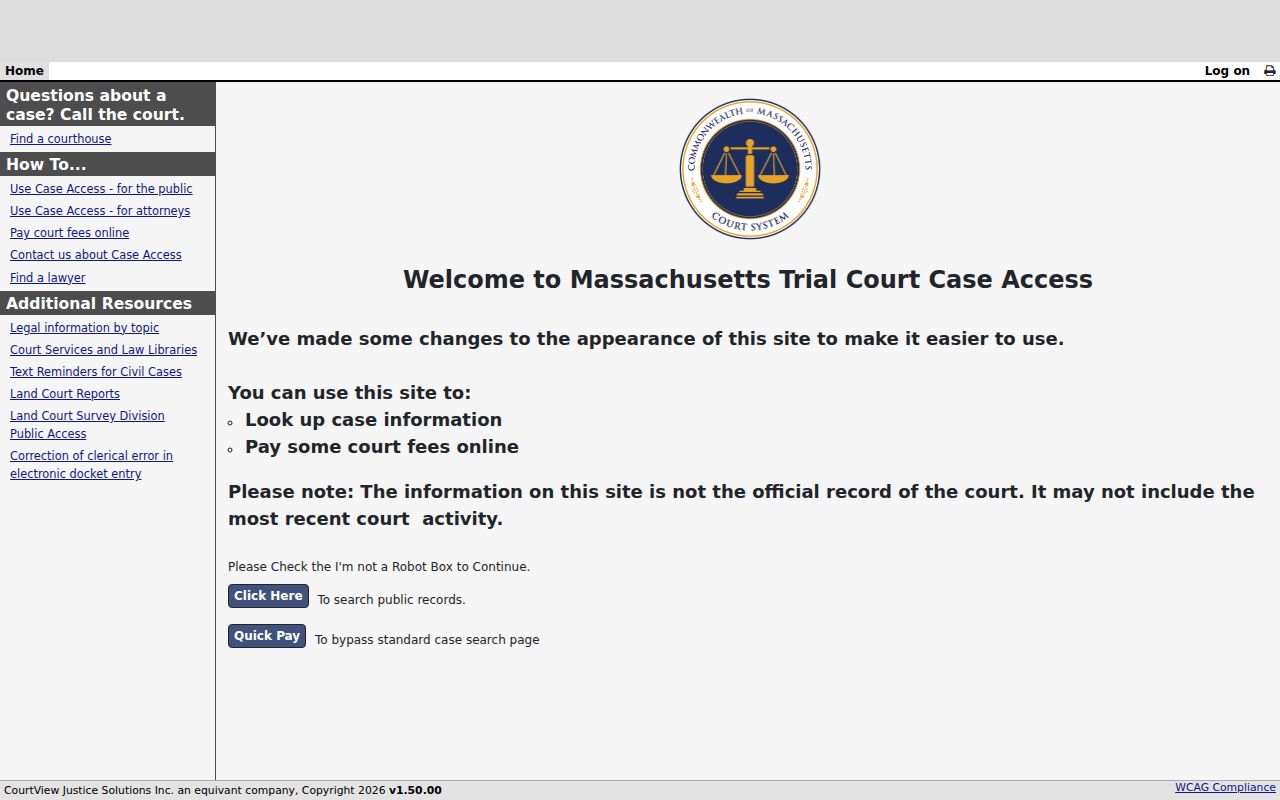
Use the warning as a reason to confirm a case number, court, and filing date with the proper clerk before relying on a docket entry.
Franklin Court Search Fields
The court instructions provide a useful field inventory, even though no real Franklin docket was opened during research. Enter only the fields appropriate to the case question. Case-number searches require exact capitalization, spacing, and leading zeroes. Case-type searches use beginning and ending dates, with the detailed instructions limiting that mode to one month. Filters such as party type and case status can reduce false matches, but they cannot prove identity on their own.
| Expected portal item | Use and limit |
|---|---|
| Department, division, location | Choose the court with jurisdiction before searching. |
| Name fields and filters | Last, first, middle, suffix, party type, status, and supported date ranges. |
| Case number and case type | Stable case identifier or a constrained date-range search. |
| Result details | Expected to include case number, parties, type, filing date, status, and activity where displayed. |
| Official-copy route | Use the clerk or register when formal proof is needed. |
The displayed result columns, document-download behavior, pagination, and redaction notices remain portal-dependent because no live docket sample was searched. Do not treat this inventory as a sample result.
The Massachusetts court-docket instructions display the department, tab, and name-search controls that shape a careful query.
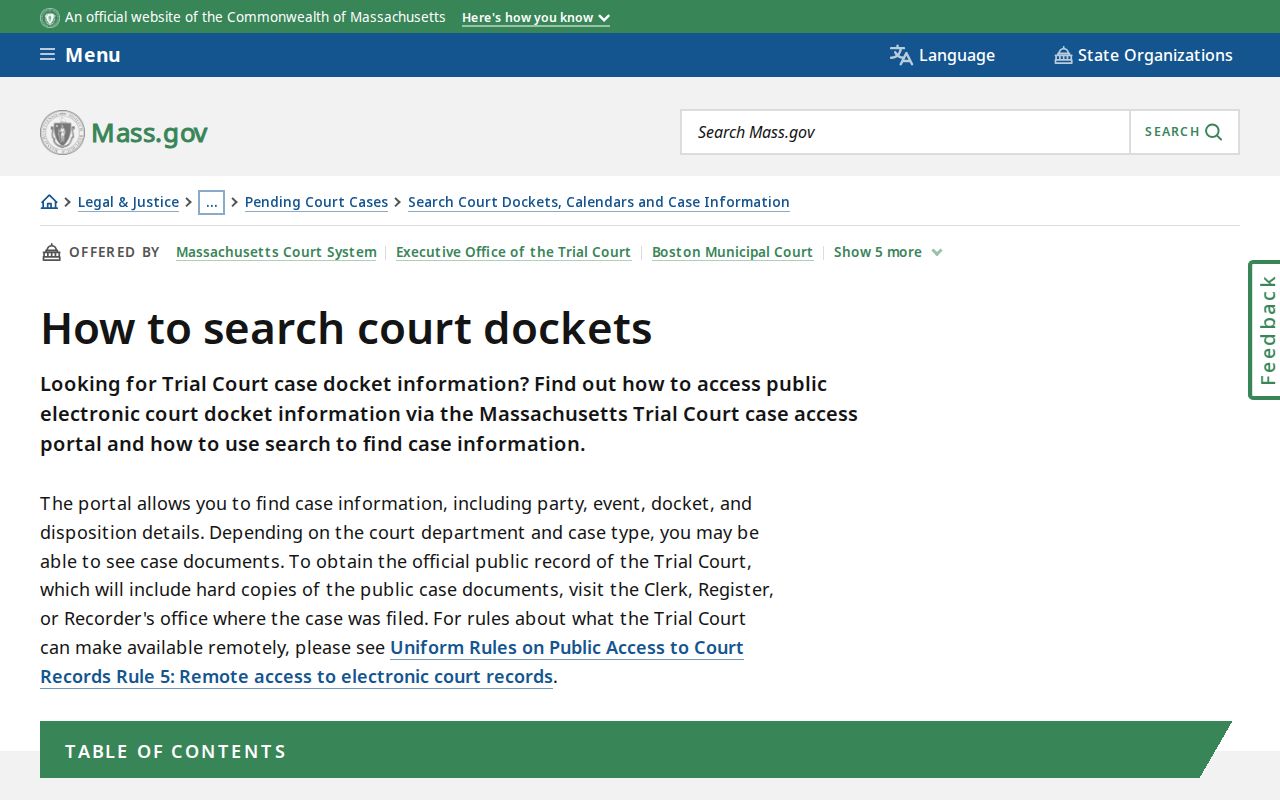
Those field choices help separate a same-name court result from the person or event being researched.
Franklin Vital Record Routes
The Franklin Town Clerk is the direct custodian for births involving people who resided in Franklin at the time of birth, marriages where intentions were filed in Franklin, and deaths occurring in Franklin. That marriage-intentions rule is a local access clue: the ceremony may have occurred in another municipality. The Clerk offers local, mail, and linked online ordering paths. The research recorded a $10 certified-copy fee, while the Town's later fee amendment lists $10 for the first certified or attested copy and $5 for an additional copy.
The statewide Registry of Vital Records and Statistics holds Massachusetts material from 1936 forward. Older records can involve the State Archives, the Town Clerk, or local repositories. Franklin Public Library's “Births, Marriages & Deaths in Franklin, 1778-2014” collection is a research aid, not a substitute for a certified copy. Birth and marriage restrictions generally change after 90 years, and death restrictions after 50 years, but adoption, relationship, sensitive-field, and repository rules still matter.
Franklin's vital-record page identifies the local record categories and the available request paths.
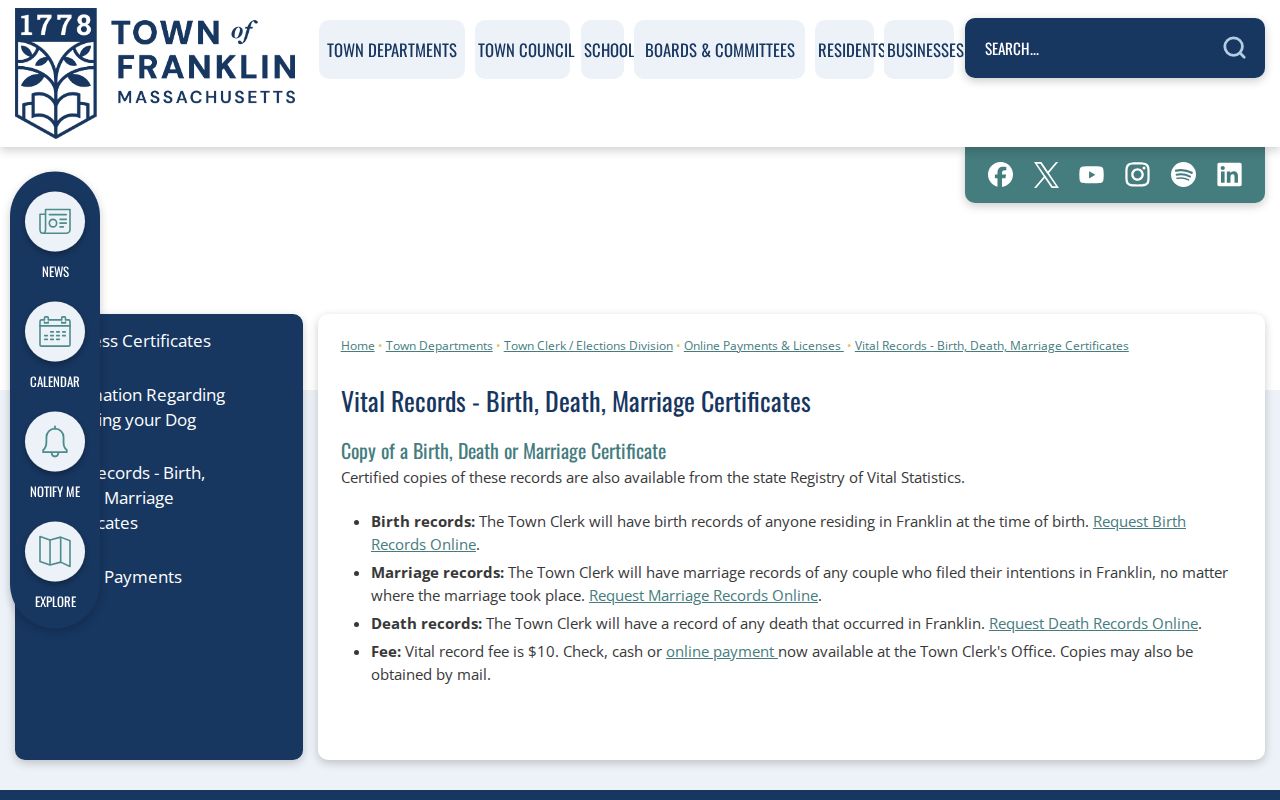
Before sending a request, confirm the event type, approximate date, and whether Franklin, RVRS, the archives, or another local office has custody.
Note: A historical index can suggest a record to request, but statutory eligibility controls whether a copy is available.
Verify a Franklin Resident
Verification means checking whether several records describe the same dated person or event. It does not mean assembling a current profile. Begin with a record that supplies a date and municipal context. For a public court question, compare the name with the case number, court, filing date, and party role. For a historical family question, compare a directory entry with a vital index, newspaper, cemetery record, or map. When an official copy matters, ask the custodian for it rather than relying on a search screen.
- Anchor the name to a dated Franklin record, such as a historical directory, parcel context, or event index.
- Check a second source with a distinct purpose, such as a deed for an instrument date or a court docket for case context.
- Compare name variants, town, date, and stable identifiers before treating the records as a match.
- Use the clerk, register, Town Clerk, or other custodian for an official or certified copy when it is needed.
- Docket
- A court's running list of filings, events, and case activity. It is not the complete case file in every setting.
- Index and image
- An index points to a record. An image is the scanned document or page, which can have different access or copy rules.
- Certified copy
- A copy issued by the record custodian with the official certification needed when a formal record is required.
Franklin Voter Record Rules
The Massachusetts voter-status form is for a voter checking their own status, or for an authorized person acting in the voter's presence. It asks for first name, last name, date of birth, residential ZIP, and an acknowledgment. It is not a bulk resident-search tool. Search tips note that a recent registration can take two or three weeks to appear and that a former ZIP may help after a move.
Public municipal voter information has a separate route. Secretary guidance identifies public fields that may include name, address, party, date of birth, active or inactive status, and voter ID, while phone, email, and confidential-voter information are not public. Franklin's Board of Registrars and Town Clerk maintain local voter lists and the annual street list. For a municipal file, contact the Clerk or use the Town Form Center, name the date and format sought, and request public fields only. The exact Franklin file format, fee, and coverage years were not located.
Franklin Records Beyond Names
Some official files are useful only for the narrow fact they record. Norfolk Registry instruments can establish a party, recording date, land description, or plan reference. Franklin assessment data can establish parcel and tax-record context. A business certificate can establish a filing history, and a state license search can verify a status. None of those records, alone, establishes present residence. Keep the owner, mailing address, parcel location, filing date, and license location in separate mental categories.
For a land record, use NorfolkResearch and the Registry's town field set to Franklin. The online start year was not located in the official landing-page text, so a no-result search does not show that a historical instrument never existed. Registry staff and the Dedham counter are the fallback. Non-official prints are free; official printed copies require the Registry's stated subscription or copy route.
Franklin's library and historical collections are often better than a current portal for a past household or institution. That distinction is an important local myth check: a deed party, property owner, or assessor mailing field does not automatically identify a current resident.
Note: Use a dated record for the fact it records and avoid treating different record relationships as interchangeable.
Franklin Public Request Routes
If an online route does not expose the needed public record, describe the record precisely and ask its custodian. Franklin's Form Center is the town access point for general public-record requests, except that police records use their separate route. The Massachusetts Public Records Law, Mass. Gen. Laws ch.66 §§6A, 7, 10, and 10A, generally provides a ten-business-day response framework, the first four staff hours without charge, permitted copying and limited hourly fees, and a Supervisor of Records appeal route.
That law does not replace court access rules, vital-record restrictions, confidential-voter safeguards, or RMV limits. Court files go to the clerk or register. Vital copies go to the office with custody. The research did not locate a general public court-file request form or a complete Franklin voter-file form, so use the named office rather than guessing at an online form.
Franklin Resident Lookup Limits
Massachusetts safeguards protected records and addresses. The Secretary's Address Confidentiality Program provides a designated address and forwarding service for eligible participants. Confidential-voter rules, court sealing, juvenile protections, vital-record limits, and RMV restrictions each have their own rules. Do not copy, infer, reverse-geocode, or combine record fragments to expose a protected address.
Use public records for lawful personal research, family history, estate matters, civic questions, or a person's own record. Stop when a record is restricted, and use an official route for correction or access. An online court entry can be incomplete, and a record may contain mistakes, so the custodian remains the source for confirmation.
Lawful use. A Franklin resident lookup is for personal, lawful research. Never use record details to stalk, harass, threaten, impersonate, or contact a protected person.